
HK & Fast Rising Seas – 3 Must-Do’s to Keep HK Safe
By Debra Tan, Jamie Chan 22 October, 2026
Capital will move to safe havens as climate risks escalate. CWR explains why HK needs a "no-regret" adaptation plan to futureproof HK as Asia's premier financial hub
While we celebrate 3 wins for adaptation in the HKSAR’s 1st FYP, we still lack a detailed adaptation plan that responds to fast rising seas. So far, all publicly available literature from the government leaves us very worried that HK’s SLR protection levels are not enough.
As SLR is virtually certain, the Netherlands goes “no-regret” and stress tests for 5m of SLR …
Scientists are “virtually certain” that SLR is irreversible and even if we stop emitting now, we have already locked in 6-9m of SLR. How much will happen sooner or later depends on whether we manage to stabilise warming. Indeed, the IPCC has warned that 2m to 5m of SLR cannot be ruled out by 2100 and 2150 (CBRO scenario) due to rapid ice melt.
So why don’t we have a “no-regret” plan for a 5m of SLR? After all, one day, it’ll be a “virtually certain” future.
At least one country is taking this seriously – the Netherlands. It is clear from the 6-year study on how to keep the country safe from SLR that concluded in June 2026, that uncertainty surrounding future SLR is not about if it will happen, but when it will happen.
The Netherlands stress tested its coastal protection strategy to 5.4m…
…it can protect up to at least 3m of SLR & as much as 5m “in principle”
So, its coastal protection strategy is subjected to stress tests at extreme CBRO levels of 5.4m, ensuring it is prepared for the very worst. If SLR doesn’t rise rapidly, 5.4m will occur far beyond 2300 but if it does accelerate, they have a plan – it can protect its delta at least up to 3m of SLR and “in principle” up to as much as 5m of SLR. This helps shore up investor confidence as well as property valuations thereby avoiding financial shocks. For our detailed review on the Netherland’s approach, see here.
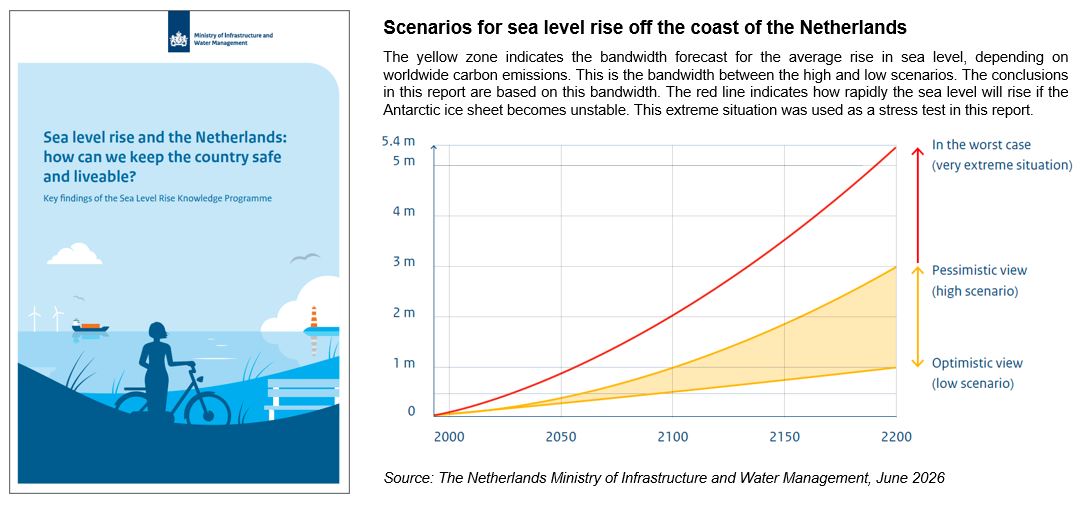
To be clear, the Netherlands is not acting to build 5m of SLR defense today but knowing the exposure at this level informs city planning and capital allocation – it allows for maximum flexible progressive adaptation strategies. As per the chart above, it has a plan in place if it needs to ramp up adaptation for 2m of SLR by 2100 in a rapid SLR scenario.
It’s possible to live with SLR! HK should follow the Netherlands’ approach…
We applaud the HK government’s “progressive adaptation” approach … but progressive adaptation to 1m by 2100 (the IPCC’s worst-case scenario) and 2.58m by 2100 (the CBRO scenario for HK) requires different strategies. The end point matters. So, we think HK should be prudent by following the Netherlands’ approach.
Here are 3 must-do’s to add to HK’s 1FYP to keep HK safe …
1. Plan for IPCC’s CBRO to account for rapid ice melt!
CBRO SLR levels pose existential threats to HK – our stress tests of over 195,000 assets in HK show clear exposure – from government revenues, housing estates, trade hubs, road/rail links, critical infra for basic needs like water & energy supply. Even HK’s key banks are exposed.
Given how fast rapid ice threats can escalate in just one year, we can no longer ignore ice melt’s contribution to accelerating SLR so we must also plan for the CBRO scenario.
Global average warming is at 1.4°C when 1°C is the safe limit for ice…
The terrifying mountain collapse that crushed thousands of people in China & Nepal is a clear sign that we’ve entered into an era of warming that is “too hot for ice”. With El Niño set to soar to 3.6°C+ in Nov-Dec this year and global average warming at 1.4°C, we are very far from the 1°C safe limit for ice.
And just like mountains in the Himalayas are starting to collapse, ice sheets/ shelves/ cliffs too will melt & may collapse in the future. When such melt happens, those of us living by the coast are all downstream of the rapid SLR this will cause. MICI – Marine Ice Cliff Instability – which causes rapid SLR is not supposed to happen in our lifetime but then again, we never thought the Himalayas which have stood for thousands of years would fall now.
Unprecedented ice melt has been observed (Greenland & Antarctica) since the publication of the IPCC AR6 in 2021 and The Royal Society in April this year, warned that without rapid and deep emissions cuts, “decision-makers must begin to fully appreciate that sea-level rises of more than 1m and even over 2m within this century, and of several metres thereafter are a real possibility”.
It was 15°C+ in June in the Antarctic Peninsula in the dead of winter when it was supposed to be -6.2°C. So duh, ice is melting fast which means seas are rising fast – it’s not just polar bears & penguins that will suffer but everyone living along the coast who have not prepared for the CBRO scenario!
2. Plan for the high-end NOT the median of the SLR range for critical infrastructure
The CEDD (the government bureau in charge of shoreline management) is using the median of the SLR “likely” projection range to plan adaptation whereas financial institutions & corporates are encouraged by the HK’s financial regulators to stress test at the high end of the “very likely” range across various scenarios for better risk management to avoid systemic financial shocks.
Risk tolerance is mismatched for public sector (50% chance of getting it wrong) vs private sector (5% chance)
There is thus a risk tolerance mismatch within the public sector as well as between the private & public sectors – adapting to the median of the range means there is a 50% chance of getting it wrong vs. the high end of the range with a 5% chance of getting it wrong. This risk tolerance mismatch must be addressed to ensure HK’s continued financial stability.
While it is not necessary to adapt to the high end of the range for the whole of HK, critical infrastructure like ports, airports, power & water utilities as well as transport links and key commercial & real estate hubs should be as they are vital for business & trade – see why we must choose wisely.
So, instead of a one-size-fits-all approach, we recommend the government to adopt higher protections for critical infrastructure as well as for high impact, high economic value areas that are essential to HK – this includes planning at the high end of the CBRO scenario for these areas in case of rapid ice melt.
3. Design infrastructure with long lifespans to match future climate conditions
Infrastructure is built to last – typically with an engineered design lifespan of 35-70 years with specialised structures such as drainage, seawalls, railways, dams & bridges pushing up to 120 years. This means they have to withstand future climate conditions of 70-120 years.
Yet, “many of these assets are still being designed for yesterday’s climate conditions. If we design only for historical rainfall and past sea levels, we are building tomorrow’s failure with today’s concrete” – valid concerns raised during a closed-door session during SIWW2026 – see key takeaways.
To counter this, Singapore’s coastal defence strategy requires that starting in 2028, all new developments, redevelopments and drainage systems with more than 30 years of remaining lease must be designed to a 2.15m relative mean sea level rise scenario whereas new critical infrastructure such as Tuas Mega Port and Changi Airport Terminal 5 will be built at least 5m or more above the current mean sea level.
HK is addressing climate risks up to 2050…
…but infra has to withstand future climate conditions of 70-120 yrs
While Singapore & the Netherlands have adaptation plans that match infrastructure lifespans, HK’s 2026 Policy Address notes that today’s flood & coastal management measures will “address flood risks up to the middle of this century” – i.e. 2050. Last year, Legco’s Panel on Development also noted that “For new development areas, such as the Northern Metropolis, the stormwater drainage systems will be designed to address mid-century climate change impacts”.
With only 25 years of climate risks up to 2050 accounted for, we worry that new infrastructure in HK may not withstand future risks. HK’s “Progressive Adaptive Approach” to shoreline management must thus be more forward-looking.
It’s not just the government but HK’s Top 4 developers must also be forward looking when it comes to responding to escalating physical climate risks.
These 3 must-do’s will futureproof HK as Asia’s premier finance hub!
Capital will move to safe havens. Currently, Singapore is sending out strong signals that the city will be protected for the future.
HK should too with these 3 must-do’s as these will help create a climate ready & resilient HK that will survive and thrive despite rapid ice melt and fast rising seas. Such actions by the government will not only protect the public but also support HK’s top listco’s as they have to now disclose how they are managing climate risks, including fast rising seas.
Everyone has a role to play so let’s roll up our sleeves Hong Kong – there’s lots to do!
Further readings
- Ice Plan B Please! 3 Thoughts on Why Financial Collapse Could be Sooner Than You Think – Fast melting ice is the systemic risk that is far from the radar of most C-suites and financial regulators. CWR runs through 3 things you should know about ice risks to protect your bottom line
- Save Our Earth! “Stop the Melt” One Year On – New research in the past year finds almost all sea level rise modelling has been underestimated. CWR sums up key cryosphere updates for our Chinese ice factsheet launch
- 5 Takeaways from SIWW2026 – Coastal threats are on global leaders’ minds this year. Which cities are ready for their future coastline? CWR unpacks key water topics from urban planning for climate overshoot to AI & water
More on Latest
- Unpacking Singapore’s New Coastal Protection Standards with PUB’s Angela Koh – Singapore’s new Code of Practice on Coastal Protection will provide landowners, engineers & contractors with greater clarity on what good coastal protection looks like & how to deliver it well. We speak with PUB’s Deputy Chief Executive Koh about the policy rationale & next steps
- HK 1st Five-Year-Plan Review: 3 Wins & 3 Wishes for a Climate Ready HK – Sea level rise finally made it into HK’s policy agenda! CWR’s Chan & Tan break down HK’s adaptation progress & the distance still to go to secure HK against fast-moving climate risks
- The Netherlands’ “No Regret” Approach to Sea Level Rise Adaptation – Already thriving below sea levels, how are the Dutch responding to a future of uncertain sea level rise? CWR’s Chan looks at the country’s holistic strategy for 2100 & beyond

Read more from Debra Tan →

Read more from Jamie Chan →
