

Ending Oil By Making Smarter Choices
By Sophie Lam 21 December, 2023
Did you know oil lurks in 95% of our everyday products? Maybe that’s why we can’t end oil… CWR's Lam unveils where oil is hiding & how you can make smarter choices
COP 28 just happened in Dubai calling for us to end oil. And while coal is set to peak by 2030, oil is expected to rise long after that. Maybe we can’t end oil because we don’t really know what it’s used for.
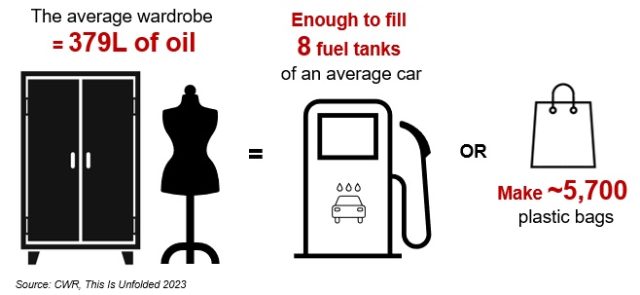
What many of us do know about oil is that it’s where gasoline comes from which we use for driving cars and it’s also where plastics come from. But did you know that oil is also in our clothes, cosmetics, hair products, perfumes, lotions, shoes, toothpaste, electronics, furniture, toys, candles, stationary, food additives plus more? The average wardrobe contains 379L of oil – enough to fill 8 fuel tanks of an average car or to make ~5,700 plastic bags. All of these contain petrochemicals, derived from crude oil, which are responsible for manufacturing over 6,000 of our everyday products.
No wonder petrochemicals, including plastic, are set to become set to the largest driver of oil by 2050. It’s high time to start making smarter choices about what we buy – or better yet, what we choose not to buy. Stick around until the end of this article to find out how you can kick off this Christmas by making smarter oil free choices.
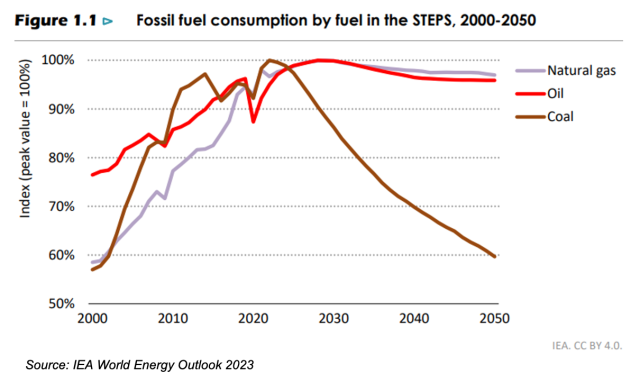
Coal is set to rapidly decline after 2030 but oil will remain close to peak levels for another 20 yrs after 2030
COP 28 just took place in oil-rich Dubai and there’s no doubt that phasing out oil was the hot topic of conversation – the Oil & Gas Decarbonisation Charter was kickstarted, the Global Decarbonisation Accelerator was launched, the Global Renewables And Energy Efficiency Pledge was made etc. Want to know more? Don’t miss out on our key takeaways from COP28.
Not long before COP 28, the IEA released a report saying that “peaks for coal, oil and gas were all visible this decade”. Finally, some great news – but there’s a catch. If you look at the graph below, the report states that while coal is set to steeply decline after 2030, oil and gas will remain close to peak levels for another 20 yrs after 2030. This doesn’t really sound like we’re ending oil and that’s bad news.
While coal is set to rapidly decline after 2030, oil will stay close to peak levels from 2030 – 2050 …
… worse still, OPEC just announced that oil demand will rise until 2045
Worse still, the Organization of the Petroleum Exporting Countries (OPEC) has just announced that oil demand will continue to rise until 2045. And while road transport currently accounts for almost half of this demand, by the end of 2030 the IEA stated that it will no longer be the primary driver of oil growth due to the rise in electric vehicles. Instead, the demand for petrochemicals – the hidden oil that’s laced in almost all our everyday products, is the reason why oil will continue to blow out of proportion…
Petrochemicals are hidden in most everyday products – the average wardrobe contains 379L of oil = enough to fill 8 fuel tanks or make ~5,700 plastic bags!
While we typically know that oil is used as fuel for transport – cars, buses, trucks, ships, and planes, and to make plastic – bottles, containers, utensils, packaging etc., did you know that oil is also used in textiles, cosmetics, furniture, pharmaceuticals, electronic appliances, computers, engine parts, adhesives, paint, detergent, fertilizer, construction etc.? You name it, it’s mostly likely in there too. According to Petrochemical Europe, petrochemicals are in 95% of all manufactured goods.
For example, 70% of clothes manufactured in 2021 were from synthetic fibers (chemicals derived from petrochemicals) – accounting for ~1.4% of global oil production, more oil than Spain used in that year. According to This Is Unfolded, a sustainable clothing company, today the average wardrobe contains 379L of oil. That’s enough oil to fill more than 8 fuel tanks of an average car or make ~5,700 plastic bags! We are literally frolicking in oil as we wrote about here. Imagine what else you own and the oil that comes with it…
Petrochems are in 95% of all manufactured goods …
… the average wardrobe contains 379L of oil = enough oil to fill 8 car fuel tanks or make ~5.7k plastic bags
In 2022, petrochemicals also emitted 5.6Gt CO2 eq of emissions – equivalent to ~10% of global emissions or more than the annual emissions of the UK and US combined in 2021. Worse still, its demand is on a booming trajectory…
Petrochemicals is set to become over 1/3 of global oil demand in 2030 & half by 2050 – ahead of trucks, aviation & shipping
Today petrochemicals make up 15% of oil demand and it is the second largest in oil consumption after transport. According to the IEA, petrochemicals are set to account for over 1/3 growth in oil demand to 2030, and nearly half to 2050 – ahead of trucks, aviation and shipping.
Already the demand for plastic has outpaced all other bulk materials like steel, cement & aluminium …
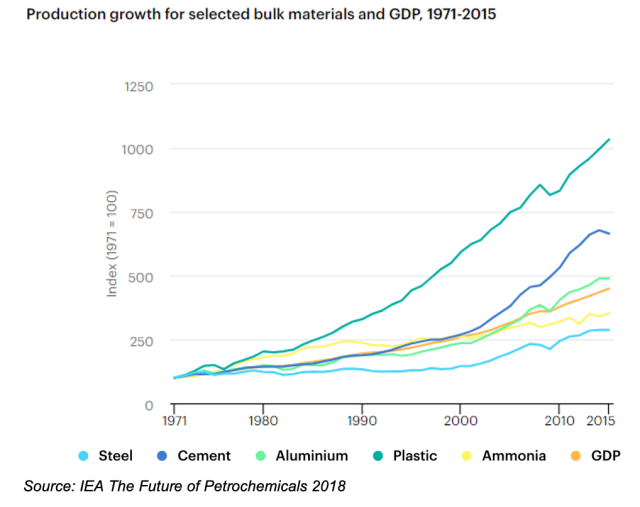
Already the demand for plastics – has outpaced that of all other bulk materials such as steel, aluminium, and cement, and has nearly doubled since 2000. At this rate, it looks like we won’t be able to end oil unless we make better choices about the products we’re buying and materials they are made of.
It’s time to make smarter oil free choices this Christmas before it’s too late!
Whether it’s going abroad this Christmas, buying gifts online, or splurging on food – try to think about the environmental impact associated with the choices you make and whether it can be avoided or reduced.
For example, Xmas gift shopping. Often times we don’t think about the emissions associated with parcel shipping or from packaging online orders but they are big. So next time, try buying gifts at local shops or pick up something closer to you. For more Xmas gifting inspo see our list of green gifts keep on giving.
A smart choice is to consume less …
… but an even smarter choice is maybe not buying it at all
Another way to make smarter choices is in the supermarket by buying hydroponic/ locally grown vegetables and plastic free produce as well. Food can have a huge impact, see how a 17 year old high school student at ISF managed to change her school cafeteria menu and cut 60% of emissions from food!
Ultimately, yes, we need to be making smarter choices to cut emissions but now that we know all these goods are tainted in oil – isn’t the real question you need to ask yourself before your next purchase is do you even need it? After all, that is the best way to cut emissions.
Want to know how you can make small habit tweaks to save the planet? Check out our Together We Can report!
Further readings
- It’s Time to Tweak Yourself to Save the Planet– CWR’s McGregor gives a sneak peek into CWR’s upcoming report that shows how simple tweaks to our habits from transport to food and shopping to being online matter for the climate
- Fashion Frolicking In Oil – Fashion is practically frolicking in oil as CWR’s Dawn McGregor points out. 2.5% of global oil produced is used by the fashion industry. See why this is and how fashion accounts for 35% of ocean microplastic
- Fast & Furious: Online Shopping’s Toxic Ways – It’s so easy to hit that ‘buy’ button, especially with it being the second year of the pandemic but CWR’s Park reminds us why we need to re-think doing that with hidden toxic costs
- Takeout Packaging – 3 Wishes For The New Year– Choking on F&B plastic packaging, Hong Kong needs to implement solutions asap. ADMCF’s Vanthournout shares key findings of their research on the most viable options
- High Flying Carbon Emissions – Rethink Your Next Trip– With no real alternatives to decarbonise, aviation is and will remain carbon intensive. CWR’s Xu makes the case to not just pile back into planes but adjust our flying habits for the better of the climate
- IPCC AR6: High Hopes For Oil & The US + China & The Rest Of Us – Rapid and big action is needed to stay within 1.5ºC. What is the best plan of action? Which sectors need major cuts? Who is still financing oil & gas? Find out and more in CWR’s key takeaways from the latest IPCC AR6 WG3 report
- G20: Don’t Just End Coal; Add Deep Cuts For Oil & Gas Too – Producing >60% of coal, oil & gas, G20 is trying to end coal yet still subsidising oil & gas. Why does this happen? Which countries are most responsible? CWR’s Ronald Leung brings to light the motivations behind
More on Latest
- COP28: 5 Firsts & Buts – Despite being dubbed the “oil COP” it achieved some key firsts, including the first-ever agreement for countries but all these came with “buts”. Check out our five reasons why despite the movement forward, we feel it’s not concrete nor urgent enough
- Catching Up with CWR’s Ex Intern Isabel Picazo on her Carbon Canteen Initiative – It’s been 9 months since Carbon Canteen completed its trial period so, we catch up with Picazo to find out how it went, what the challenges have been & what’s next
- Green Gifts That Keeps On Giving – Ready for a greener holiday? CWR’s Chai shares five environmentally friendly gifts that keep on giving – think experiences, donating, renewables & more

Read more from Sophie Lam →
