
2025 State of Ecology & Environment – Marine
By CWR 22 June, 2026
China's ocean quality recovers from a slight dip last year & continues improving steadily. Check out our annual review for an update
On June 4, 2026, China’s Ministry of Ecology and Environment (MEE) released the 2025 State of Ecology and Environment (SOEE) Report, finding that China’s marine water quality has continued improving overall, following a minor drop in quality in 2024.
Key highlights from the 2025 SOEE Report are…
- The overall water quality of the seas under jurisdiction “remained stable” & improved; “Good” quality (Grade I-II) water improved slightly by 0.1 percentage point to 97.8% in 2025;
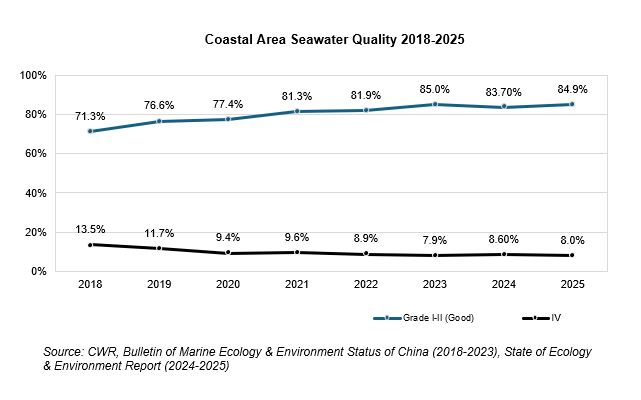
- The overall seawater quality of coastal areas has improved: “Excellent/Good” category (Grade I-II) rose from 83.7% in 2024 to 84.9% in 2025;
- Sea areas that increased Category IV+ water quality were Hebei, Tianjin, Shandong, and Jiangsu;
- The overall water quality of rivers flowing into the sea across the country is generally in good status; and
- The environmental quality of beaches and marine fishery areas is generally in good status.
We deep dive into seawater quality of China’s coastal areas below…
| To better understand the terminology of water quality used by the report, please refer to the following list: Grade I: suitable for source water and national natural reserve Grade II: suitable for domestic use (first rate), rare aquatic lives (and some other uses) Grade III: suitable for domestic use (second rate) (and some other uses) Grade IV: suitable for industrial use and entertainment use (without contact with human) Grade V: suitable for agricultural use Grade V+: not suitable for any use |
Coastal Area seawater quality improves steadily, recovering from minor 2024 dip
Seawater quality in China’s coastal areas has been improving steadily since 2018, as shown in the chart below. From 2024 to 2025, “Good” water quality (Grade I-II) increased by 1.2 percentage point, following a slight drop in 2024. Grade IV+ category water also recovered by falling from 8.6% in 2024 to 8% in 2025.
Sea areas under jurisdiction of China remained stable
The status of seas under China’s jurisdiction remained stable and improved from 2024’s slight dip.
The sea areas meeting Grade I slightly improved from 97.7% in 2024 to 97.8% in 2025, while Grade IV+ slightly improved by dropping from 0.8% in 2024 to 0.6% in 2025.
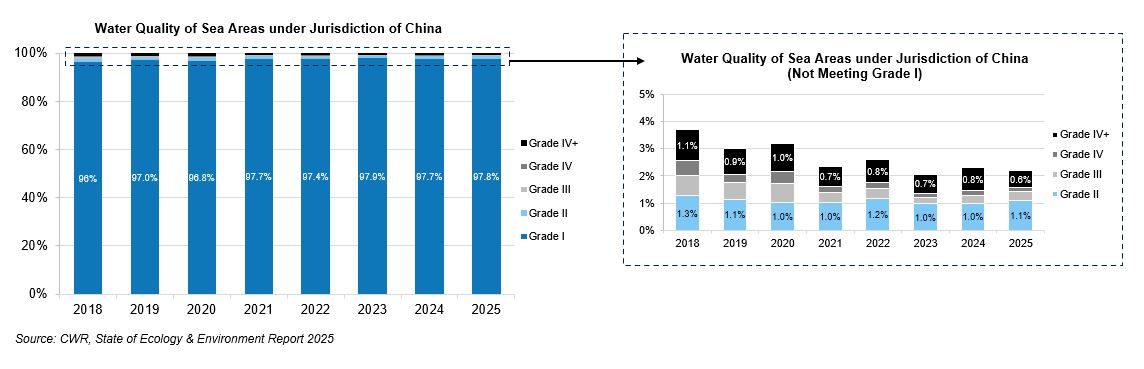
As most of the seawater category is Grade I, we take a deeper look into the 4 major seas’ water that are worse than Grade I (Grade II-IV+) below.
East China Sea has the most area not meeting Grade I; Bohai Sea has the least
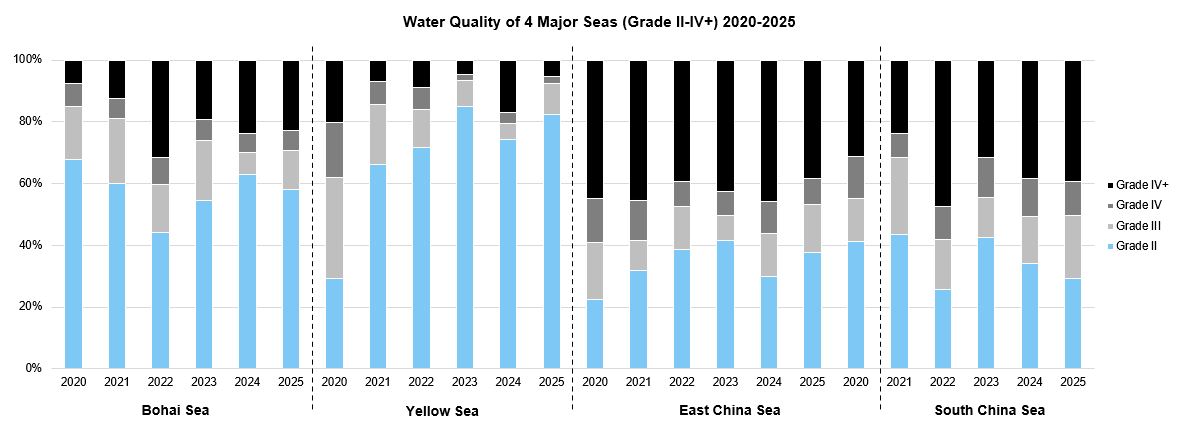
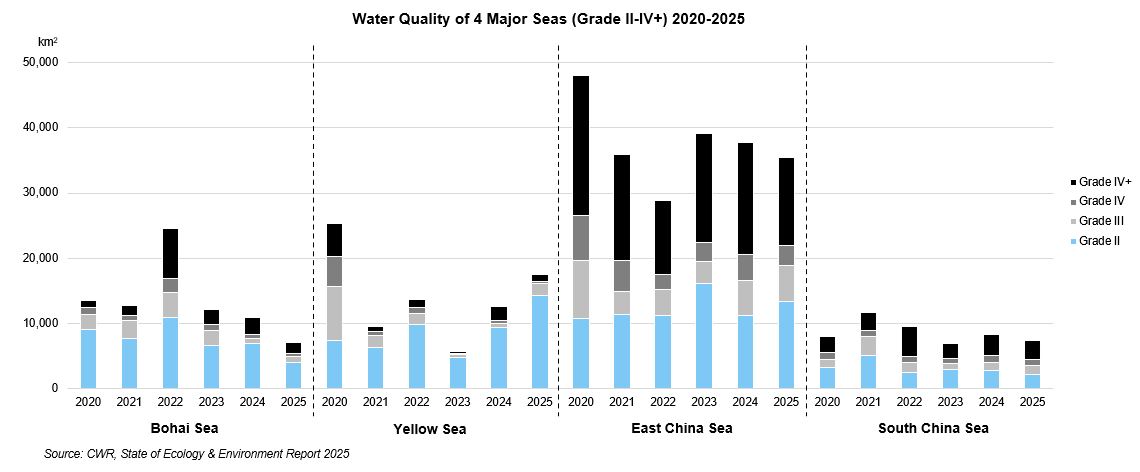
The overall seawater quality in China remained stable with the majority in Grade I category. Among the four major seas, reductions in Grade II-IV+ waters were seen across the Bohai Sea, the South China Sea, and the East China Sea, but the Yellow Sea Grade II-IV+ waters increased by 38 percentage points compared to last year.
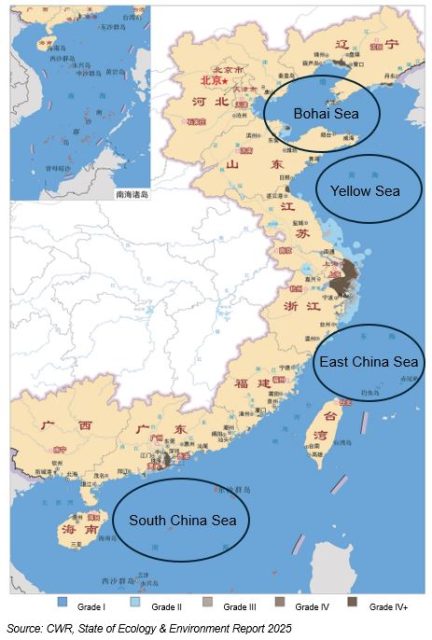
In 2025, the East China Sea had the most sea area in Grade II-IV+ category with 33,500km² while the Bohai Sea had the least with 7,030km².
For the worst quality Grade IV+ category, South China Sea has the highest share (39%) while Yellow Sea has the least (5%), as shown in the chart below. All seas saw a decline in this water with the most progress seen in the Yellow Sea, which cut its Grade IV+ water by half in 2025. Note that this comes after an 8x increase in the previous year.
In 2025, the MEE continued to enhance its beautiful bay construction while improving marine ecological quality. There are now 168 bays with over 85% of their waters considered good quality. By the end of the 14FYP, there were 74 “beautiful bays” nation-wide, achieving 26% of its 40% construction goal by 2027, as stated in the Action Plan for Enhancing the Beautiful Bay Development (美丽海湾建设提升行动方案).
The MEE will also work with relevant departments and coastal areas to create more beautiful rivers and bays, led by 12 excellent case studies that include Xiamen and the HK-Shenzhen Mirs Bay.
To better control sewage and marine pollution, the MEE has released 2 new standards in 2026: a technical guideline for sewage outfall constructions and a new quality standard for cadmium in marine waters.
We will see whether these measures will continue to improve China’s seawater quality.
Further readings
- 2024 State of Ecology & Environment – Marine – The marine ecology & environment of China remained stable, but we see slight deterioration for the first time since 2018 – ‘Excellent/Good’ coastal waters has slightly dipped to 83.9% this year. Dive into our yearly review to learn more
- 2023 Marine Ecology & Environment Status Review – The marine ecology & environment of China continues to improve, with a remarkable 85% of its coastal waters classified as ‘Excellent/Good’. Dive deeper into our review of MEE’s annual report to learn more
- 2022 Marine Ecology & Environment Status Review – Though overall coastal water quality remained stable, there’s still a lot of clean-up needed. Get the latest in our review and find out which sea’s Grade IV+ worsened by a whopping 388% and more
More on Latest
- 2025 State of Ecology & Environment – Freshwater – At the end of the 14FYP & after 10 years of the Water Ten, we take a look at China’s progress on improving water quality in 2025. Despite some ups & downs, all 14FYP freshwater targets were achieved
- Flood of Opportunities in Ecological Preservation – China’s ecological civilisation is more than ideology but a proven approach to turn climate risks into new opportunities. Water policy professors Biswas, Wang & Tortajada show us how
- Hong Kong’s Moment to Lead in Nature Finance – Nature is the backbone of the global economy yet it’s consistently neglected in sustainable finance. Conservation finance specialist Martin offers a blueprint for HK to expand Asia’s green bond market into nature positive investments

Read more from CWR →
