
Top 4 HK developers ill-prepared for climate risks!
By CWR 24 February, 2025
New CWR report points to material write downs & insurance hikes for tycoons with stakes in listco’s with assets worth over HK$2.3trn as resilience measures disclosed are not commensurate to escalating risks ahead
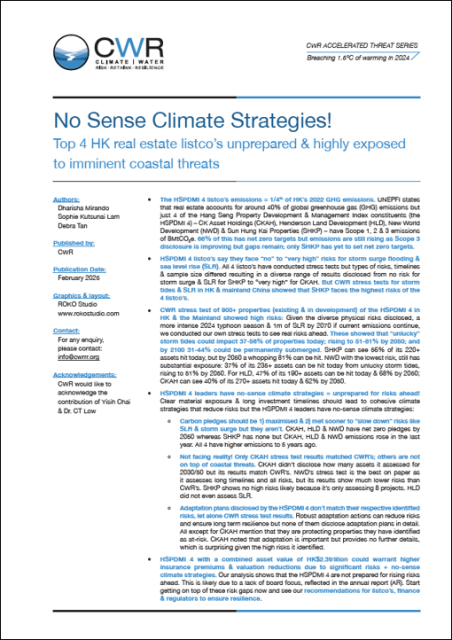
Hong Kong, 24th February 2025 – CWR releases a new report: “No Sense Climate Strategies! Top 4 HK real estate listco’s unprepared & highly exposed to imminent coastal threats” pointing to material write downs for tycoons with significant stakes in listed companies with assets worth over HK$2.3trillion (US$295billon). The report warns that climate resilience measures disclosed by these companies are not commensurate to escalating risks ahead – adaptation plans disclosed do not even address the respective risks identified by the companies, let alone CWR’s stress test results which reveal that 37-56% of their properties could be at risk from “unlucky” storm tides today. Worse still, up to 18% of a single developer’s assets are on track to be permanently submerged by 1m of sea level rise (SLR), which scientific consensus now says could occur by 2070 if current emissions continue. Ultimately, total emissions are still rising for all four developers despite net zero pledges by three of them. If board directors do not prioritise transition or climate risk defence, material coastal threat exposure could warrant valuation write downs and insurance hikes said the report.
The four listco’s (called the HSPDMI 4 in the report), are all constituents of the Hang Seng Property Development and Management Index. They are titans of Hong Kong’s real estate sector – CK Asset Holdings (CKAH 1113:HK), Henderson Land Development (HLD 0012:HK), New World Development (NWD 0017:HK) & Sun Hung Kai Properties (SHKP 0016:HK). Together, they derive HK$133billion (US$17billion) of revenue from Hong Kong alone and their all-scope emissions amount to 8MtCO2e, almost a quarter of the SARs 2022 GHG emissions. CWR reviewed them to see if 1) physical risks pertaining to coastal threats disclosed by the listco’s are realistic; 2) whether adaptation strategies match the risks that lie ahead; and 3) how transition is progressing as this will “slow down” escalating climate risks.
CWR’s report exposes material write downs & insurance hikes for tycoons with significant stakes in listco’s with assets worth over HK$2.3trn…
…stress tests reveal 37-56% of their properties are at risk from “unlucky” storm tides today
“The HSPDMI 4’s climate strategies and our own stress tests of 900+ assets in Hong Kong and the Mainland revealed stark gaps on multiple fronts – only one company’s disclosed physical risk levels matched our stress test results – CK Assets Holdings. The rest had a poor grasp of risks likely due to sampling issues, tool selection plus failed to evaluate significant chronic risks like sea level rise” said Dharisha Mirando, CWR’s Finance Lead and author of the report. As physical risks are tied to locations, CWR expected the risks identified by the HSPDMI 4 to be somewhat similar due to their operational geographies, but coastal threats varied widely – from “very high” risk in HK and the Mainland to “low-medium” risk; even no risk for storm surge and rising seas was disclosed.
CKAH was the only listco whose stress test results matched CWR’s…
…but all developers’ adaptation plans failed to address even their own disclosed risk levels
Although CKAH’s risk assessment matched CWR’s, the report notes that the company fell short on adaptation disclosure – saying that adaptation is important but provided no further details despite the high risks it identified. But it’s not just CKAH that’s not climate-ready, in fact Mirando said “all four developers’ disclosed adaptation plans even failed to address their own disclosed risk levels – we had expected them to do better as resilience can reduce insurance premiums plus preserve asset values for future sales”. Pointing out that “This is not impossible – Link Asset Management was able to reduce its insurance premiums by stepping up flood adaptation – payback is immediate for acting now”.
The think tank found the HSPDMI 4‘s lack of cohesive climate strategies from physical risk recognition to adaptation and transition worrying. NWD’s climate strategies were the most maligned according to the report. “New World’s stress test was the best on paper as it assessed long timelines and all risks but its results show much lower risks than CWR’s” explained Mirando. This underestimation of risks was all the more surprising as NWD’s board appeared to be the most engaged on climate risks with 70% of the 700+ climate-related words in the sustainability report making it into the annual report, whereas the others ranged from 6-23%, the report states.
NWD looked “best on paper” with most board focus on climate risks, but was likely let down by its stress testing quality leading to risk gaps
“While New World’s board seems to be the most engaged on physical risks, it’s likely let down by the quality of its stress testing and tools used resulting in massive risk gaps” she added. NWD disclosed moderate to extreme risk from tropical cyclones due to wind & rainfall but indicates insignificant risk from storm surge & SLR in HK and only minor risk in the Mainland. In contrast, CWR’s stress tests of 235+ assets show 32-37% can be hit today by an “Unlucky Mangkhut” storm tide.
The head of the Hong Kong based think tank, Debra Tan also pointed out that of the four developers, NWD was the most exposed to 1m of SLR (18% vs. 2-7%). “Since we could see 1m of SLR before 2070 if emissions continue, we expected properties under development to be less vulnerable than existing portfolios. We see three listco’s reducing their risks, but New World bucked the trend. No matter what scenario, New World’s properties under development are more at risk than their existing assets – this has serious accountability and fiduciary implications,” highlighted Tan.
SHKP was a clear laggard with no net zero targets + had the worst grasp of climate risks…
…whilst HLD didn’t even stress test for SLR, despite CWR’s stress tests revealing 1/3rd of its portfolio could be underwater by 2100
That said, the report showed SHKP to be the clear laggard – it’s the only one without net zero targets plus it had the worst grasp of climate risks. “Sun Hung Kai found no high risks from its own stress tests but ours showed a shocking 56% can be at risk today from unlucky storm tides going up to 81% by 2050” clarified Mirando. “This massive risk gap could be due to sample size – Sun Hung Kai only assessed 8 projects, whereas we analysed over 220 assets”.
An incomplete view of climate risks was also the case for HLD, which said it performed stress tests for acute but not chronic risks such as rising seas. “While we commend Henderson Land for announcing SBTi aligned net zero pledges in January 2025, ignoring rising seas only leaves the company blind to the fact that over a third of its portfolio will be permanently underwater by 2100 if emissions continue” said Mirando.
Rising seas are indeed a worry. Tan updates that a 2024 Singapore study now says 1.9m of SLR by 2100 is possible. “This means we’re now likely tracking the IPCC’s “cannot be ruled out” scenario of 2m SLR by 2100” she said. But we’ll be inundated sooner: Tan warns “a recent global study of coastal flooding says Hong Kong will face ‘minor’ floods almost every day at 1m of SLR and ‘major’ floods once every 5 days – at this rate, this can happen by 2070, or even earlier given regional disparities in SLR. We must start preparing now”. Flood costs can be exponential – the HKMA’s pilot climate stress test in 2021 stated that ~HK$1trn or 32% of property related lending of 27 HK banks is pledged with collateral in vulnerable areas exposed to typhoon & flood risks; and this was only based on ~0.55m of SLR by 2050.
Now that we could see 1m of SLR by 2070 & 1.9m by 2100 – the magnitude of risk exposure for real estate, insurance & banking underscores the importance of stress testing…
…plus with the upcoming low-lying Northern Metropolis project + ISSB Standards, regulators & governments must step up
The magnitude of exposure for the real estate, insurance and banking sectors underscores the importance of stress testing. Here, CWR says that financial regulators have important roles to play. “What’s clear from our report is that disclosure of physical risks can be misleading plus benchmarking is difficult due to different stress test parameters, timelines and tools. With rising climate risks, investors will increasingly rely on climate disclosures so regulators must set better guidelines to standardise stress testing to ensure they are comparable and credible,” said Tan.
This ask is timely following the release of HK’s roadmap on sustainable disclosure by the FSTB in December 2024, which indicates full adoption of the ISSB Standards no later than 2028 for large publicly accountable entities. Already, large caps face “comply or explain” for some aspects from 1 January 2025 with more becoming mandatory in 2026.
But the report acknowledged that the developers’ risks cannot be reduced without government adaptation action. “Government action is key but we’ve yet to see transformative city-wide adaptation plans for HK to address existential threats from multi-metre sea level rise, which is becoming increasingly likely every year we don’t cut emissions – we’d like to see the HSPDMI 4 take a more proactive lead in engaging the government” Tan suggests. On transition, she notes that both the sector & the government can push for faster global decarbonisation by tackling embodied carbon – “if Vancouver can set targets to reduce embodied carbon in construction by 40% by 2030 – Hong Kong can too.”
Apocalyptic fires in LA and devastating floods in Spain means it’s harder to ignore rising climate risks. So far, Hong Kong has been spared from direct hits from several super typhoons last year. Guangdong, Hainan, Vietnam, Thailand & the Philippines were not so lucky – Super Typhoon Yagi which skirted past Hong Kong with winds of over 230km/h affected millions and caused almost US$14billion in economic damages with over 450,000 homes destroyed.
Despite shocking findings, CWR remains optimistic….
“1) Accept that impacts are tracking IPCC wort-case projections so update for real risks ahead; 2) adapt, adapt, adapt & collaborate; and 3) up carbon pledges to “slow down” risks”
The report is a wake-up call, especially ahead of the HK$224billion Northern Metropolis project, which is low-lying. CWR’s stress tests for impacts today used a storm tide range of 5-6m; this would have been a direct hit from Typhoon Mangkhut at high tide. Even a T1 in November 2024 caused water levels to reach 3.36m above Chart Datum in Quarry Bay & Tai O and 3.52m in Tai Po Kau. With annual warming of 1.55°C for 2024, Tan urged “We must face the reality of ever growing risk gaps as adaptation is not catching up with fast-moving climate risks – physical risks are now escalating at a rate that even science and risk assessment tools are playing catch up”.
While the findings were shocking, CWR remains optimistic and hopes that the report can help the HSPDMI 4 as well as other stakeholders from finance, governments to NGOs ensure better alignment of climate strategies for resilience. Mirando aptly sums “Property prices are down and the economic outlook remains poor due to contentious geopolitics, but with the US out of the Paris Agreement again, global warming and climate risks will likely accelerate. So, 1) accept that impacts today are already tracking IPCC worst-case projections so update stress tests for real risks ahead; 2) adapt, adapt, adapt and collaborate; and 3) up carbon pledges plus meet them sooner to “slow down” risks like SLR & storm tides. Climate change waits for no one – we need sensible climate defence strategies now to preserve value.”
 Media
Media
For more information, please contact: Dharisha Mirando
Email: dmi@cwrrr.org
Quick access – Infographics/charts
- HSPDMI 4’s Climate Pledges, Stress Tests & Adaptation Strategies: at-a-glance timelines, scenarios, risks, assets analysed & stress test results
- HSPDMI 4’s Own Stress Tests… see what they say is at risk
- CWR’s Stress Test Results for the HSPDMI 4… see summary For detailed results – see factsheets below)
- HSPDMI 4’s adaptation plans… see summary
- HSPDMI 4’s Carbon Related Disclosure: at-a-glance emissions, electricity, pledges, carbon management, ESG + see which Scope 3 categories are disclosed
Quick access – Key takeaways & Factsheets
- Executive Summary
- Recommendations for listco’s, finance & regulators to ensure resilience
- 3-page Factsheets for the HSPDMI 4:
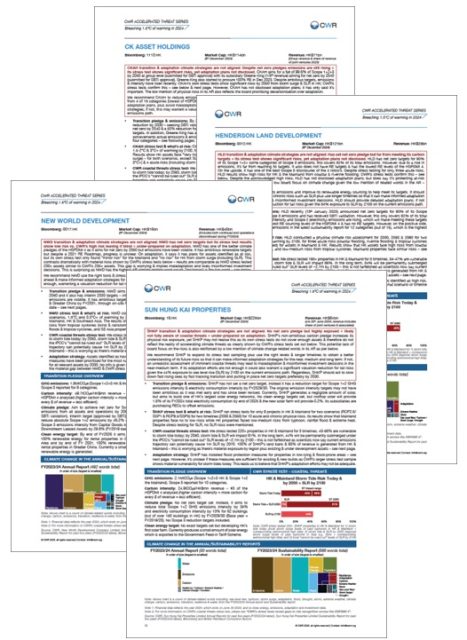
- Contains at-a-glance overviews of the listco’s own transition pledges + key energy & emissions data; physical risk stress test results; adaptation strategies disclosed & financials
- + CWR analysis of board focus on climate risks: AR vs. sustainability reports; CWR stress tests of multiple scenarios; risk exposure of properties in HK & Mainland; risk exposure of existing properties vs. under development:
- HKSAR government adaptation efforts disclosed so far leave HK assets at risk
- Face reality – see what accelerated heating means for storm tides & SLR
- CWR stress test methodology: SLR & storm tide
- Higher premiums & valuation write-downs: why the HSPDMI 4’s could face higher costs from no-sense climate strategies
Further readings
- Assets at Risk due to Short-term Climate Risk Assessments – Companies must conduct more realistic climate risk assessments to protect assets from chronic risks. CWR’s Dharisha Mirando uses Hong Kong & New World Development as an example
- CWR talks to Link REIT on Building Low-Regret Resilience – Link REIT had CWR stress test its GBA portfolio against IPCC “low-regret” scenarios. We chat with Dr. Kwan, Head of Sustainability & Risk Governance, on being early movers and discuss key findings & benefits
- Building Too Close to the Water. It’s Ridiculous! – Reeling from climate disasters, it’s time for managed retreats & buyouts in Australia. O’Donnell, Honorary Associate Professor at ANU, expands
- Who Will Pay For New Zealand’s Most Vulnerable Coastal Properties? – Sobering data on sea level rise shows water is now lapping close to a lot of New Zealand’s front doors but who will pay when it causes flooding? Not insurers. Logan, Lecturer of Civil Systems Engineering from UoC, expands
More on Latest
- A Conversation with Dr. Calvin Lee Kwan on Link’s Risk Insurance Premium – Despite rising climate risks, Link’s proactive adaptation efforts secured a material insurance premium cut. We talk to Link’s Sustainability & Risk Governance Head on how to turn climate action into savings
- Beyond Net Zero in HK: Much to Lose & Everything to Gain – Decarbonisation & engineering specialists McNeill & Karpe, founders of IXO Partners, share 5 prong recommendations for HK to trailblaze from holistic retrofitting, reforming building regs to reducing embodied carbon in construction
- Hiss or Miss? 5 Trends for the Year of the Snake – The Wood Snake, simultaneously opportunistic & dangerous, slithers us into a year of escalating climate risks & volatile global politics. Will 2025 be a hiss or miss? Don’t slide backwards, ‘ladder up’ with our 5 trends for 2025

Read more from CWR →
