

Financing Glacier Bonds with ADB’s Noelle O’Brien
By Noelle O'Brien 20 May, 2026
With a US$100mn bond for glaciers now launched, O'Brien shares that ADB is on a mission to translate cryosphere risks into bankable opportunities

Read more from Noelle O'Brien →
Preserving Himalayan glaciers are critical to Asia’s security – we’ve said this again and again. So, it’s super exciting that the Asian Development Bank (ADB) launched a US$100mn “green bond to raise awareness of glacier melt” in March 2026 to protect this critical system.
Today we chat with Noelle O’Brien, ADB’s Director for Climate Change Strategy and Engagement, to learn about what this means for the future of glacier financing.
CWR: We’re thrilled to see ADB launch a US$100mn green bond to raise awareness of glacial melt. Can you share with us the journey that led to this fundraise? What will the funds go towards? Which countries will benefit?
Noelle O’Brien (NB): Glacier- and snow-fed river basins support water security for around 2 billion people in Asia. However, they are at risk, which threatens drinking water, agriculture, food security and energy generation for many across South Asia and Central and West Asia.
As we mark the close of the UN International Year of Glaciers’ Preservation, the timing of the transaction allows us to amplify focus towards glacial melt, and its impacts on the vulnerable communities supported by ADB initiatives.
The goal is to embed glacier-related risks into national climate strategies…
…& strengthen early warning systems for GLOFs
We are also leading a portfolio of programs that advance glacier monitoring, risk-informed planning, and climate-resilient infrastructure. These include Building Resilience in the Hindu Kush Himalaya (BARHKH), Glaciers to Farms, the Resilient River Basins Initiative, and the CAREC Water Pillar. The goal is to help governments embed glacier-related risks into their national climate strategies and strengthen early-warning systems for glacial lake outburst floods (GLOFs).
The Glaciers to Farms program alone spans nine countries in Central Asia, South Caucasus and Pakistan, supporting everything from efficient irrigation and water storage to adaptive social protection for communities facing water shortages and extreme heat stress. It’s part of a larger $3.5 billion commitment ADB is making over the next decade, in partnership with the Green Climate Fund, to build glacier resilience across the region.
CWR: You partnered with BNP Paribas & Morgan Stanley to arrange this bond – how are you making the business case for glacier financing to private investors? Do you find that there’s growing interest from them?
NB: ADB applies a conservative and rigorous process to project selection under its Green and Blue Bond Framework, and investors have consistently recognised and valued that discipline. Investors trust our green bond label and this recognition allows ADB to continue mobilising capital for specific mitigation and adaptation projects across our member countries.
CWR: Still, it’s not easy to raise capital for glacier-specific projects. What remains the key barriers that need to be addressed for more new issues in this space?
NB: Building trust and strong relationships with investors is key to issuing bonds in the capital markets. There is no difference for our green bonds which remain a key funding tool for ADB. Through our robust project pipeline, we provide investors with longevity in our ambitions to support the affected communities and region.
As such, we saw diversified and robust interest, particularly from European investors. And the follow-up interest post-issuance reinforces our view that ADB’s debt program will continue to attract the capital needed to drive our mission forward.
CWR: More investment in resilient water systems will be needed as glaciers melt faster. Are you working on any other innovative glacier financing solutions? What should we keep our eyes out for?
NB: Through the Glaciers to Farms and BARHKH initiatives, we are looking at ways to scale investment in resilient infrastructure and water systems by linking upstream glacier risks with downstream economic impacts.
This includes developing blended finance approaches, risk transfer solutions, and investment platforms that can mobilise both public and private capital for water security, resilient infrastructure, and climate-adaptive agriculture.
ADB is moving focus from awareness to scalable investment solutions
ADB is working on the development of financing solutions that better translate cryosphere risks into bankable opportunities. The focus is moving from awareness to scalable investment solutions that can be replicated across glacier-dependent regions.
CWR: For those who are still not convinced about the importance of glaciers… what would you say to them?
NB: Nearly 2 billion people depend on glacier-fed river systems for their water, food, and energy. Glaciers act as natural water towers, regulating river flows that sustain agriculture, cities, and hydropower systems across entire regions.
As they melt faster due to climate change, the impacts are already being felt with more risks arising like frequent floods, GLOFs, landslides, and extreme events in the short term, followed by long-term water scarcity and reduced energy generation.
Melting glaciers are economic risks so investing in adaptation will save immense costs in the future
These are not environmental issues alone; they are economic risks that affect infrastructure, public finances, and livelihoods. Investing in adaptation today will help save immense costs in the future, reducing the fiscal burden on glacier-dependent countries.
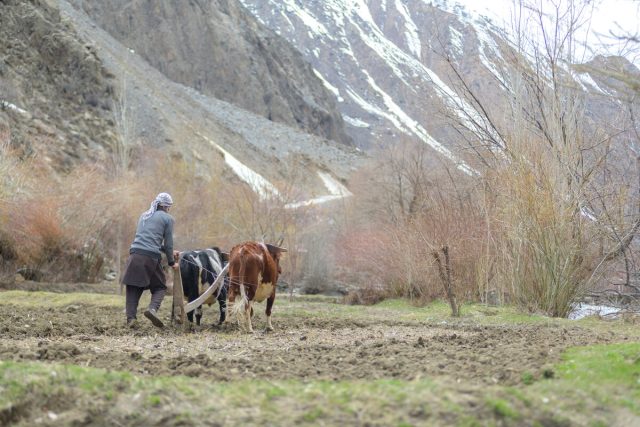
Siraj plowing in forms using cattle, this year, people have faced late snowfall, due to which farmers could not sowing the seeds on time, Tuesday 26 March 2024. ADB has placed climate change and its consequences at the top of its development agenda and scaling up support to address climate change. Source: ADB Photo, Rahim Mirza.
Further readings
- A Conversation with ADB’s Yasmin Siddiqi on “Glaciers to Farms” – How are Central & West Asia adapting to disappearing glaciers? We ask ADB’s Siddiqi about their US$3.5bn project to support agriculture, disaster readiness & water security in the region
- Melting Mountains: Rethinking Infrastructure and Resilience in the Hindu Kush Himalaya – As deadly glacial disasters in the Himalayas are on the rise, ICIMOD’s Dr. Zhang calls for more resilient infrastructure & better community preparedness
- No Water, No Growth 2 – Rising river risks threaten half the GDP of 16 Asian countries – Asia’s future hinges on the Himalayan rivers but can they continue to support the continent’s growth in a changing climate? Find out which countries are leading or failing in “waternomics” from CWR’s latest report
More on Latest:
- Investing in Farmers for Climate Resilience with Acumen’s Tamer El-Raghy — Growing climate volatility is destabilising global food production so El-Raghy explains why Acumen invests in smallholder farmers & how markets benefit
- Beyond Green Bonds: Why Hong Kong Should Build a PPPP Platform — As resilience solutions often don’t fit the risk appetite of conventional finance, Harris believes HK could build a platform to close the region’s climate, adaptation & development funding gap
- The Future of the Blue Economy: Why Asian Families Must Step Forward — Asia’s shipping families already know fuel efficiency & next-gen vessels are good for business, but more gains await from investing in ocean decarb & restoration
