
Nature Makers Lab’s Camilla Zanazanini on Typhoon-Proof Micro-Forests
By Camilla Zanzanaini 22 January, 2026
Manicured urban parks may look pretty but are devoid of life & resilience. To counter this trend, Zanzanaini is planting hotspots of nature throughout HK to spread the benefits of biodiversity


Read more from Camilla Zanzanaini →
Nature Makers Lab creates small-scale forests in Hong Kong using the innovative Miyawaki forestry method – which makes it possible to grow thriving ecosystems even in limited urban spaces. We spoke to founder Camilla Zanzanaini about why not all green is created equal, and the mindset shift needed to go from preferring nature as “tidy” to nature as alive, biodiverse and functional.
CWR: Thanks for chatting with us, Camilla! First things first – what is a Miyawaki forest?
Camilla Zanzanaini (CZ): The concept of a Miyawaki forest was developed by Japanese botanist Akira Miyawaki. The core principle is to mimic nature when it comes to restoring degraded land. This has since been adapted to the urban environment, and some of the key features are – only plant native species, plant a diversity of trees and shrubs representing different layers of the forest, and plant them very densely (up to 4 plants per m2).
A 100m2 Miyawaki forest can benefit up to 1,000 birds, bees & butterfly species
As Miyawaki forests have been growing around the world in the last decade, we have found that this concept can work in spaces as small as 25m2 – just above the size of 2 parking spaces. In Hong Kong, a 100m2 site can host up to 400 native trees and shrubs, benefitting up to 1,000 birds, bees and butterfly species.
These forests help reduce air and noise pollution, prevent flooding, act as typhoon buffers and can be designed to include spaces for outdoor play and spiritual connection.
CWR: What inspired you to start growing native forests in Hong Kong, a place more known for its skyscrapers than its biodiversity?
CZ: When I started Nature Makers Lab four years ago, I was fascinated with the idea of playing a role in healing nature. A lot of the greening I saw around the city was only designed for people, or to be pretty, but it wasn’t really doing anything for biodiversity.
Our vision is to create a nature community for people & wildlife
Our vision is to create accessible natural spaces that are not just a place for people, but a nature community that provides food and habitat for wildlife. At the end of the day, biodiversity comes down to this: if something has somewhere to live and something to eat, it will come.
I’m from Hong Kong originally and I’ve been very lucky that I’ve always lived close to nature. Growing up, my best friend was a tree! However, in Hong Kong, the overall mindset towards plants and landscaping is still very much aesthetic over function. When I go to the flower market, the plants look like they’re on steroids – they’re so polished and perfect. It’s quite creepy to see because it’s such a contrast to my daily relationship with plants.
People are so used to seeing something that is very tidy and curated, but that’s a very warped version of what nature should look like. For example, one of the biggest barriers to a Miyawaki system for property developers is that it doesn’t look good right away from day one. But we see an opportunity here, to bring people in to engage with nature. Planting a tree and watching it grow is a great way to build community as well as integrate humans with nature.
Miyawaki forests have a clear return period…
…making it easier to secure investments
Being able to create a forest quite quickly also made sense from a business perspective. Even though I don’t like thinking of a Miyawaki forest as a product, the concept can be more easily packaged as one. For bigger conservation or restoration projects, one of the hardest things to get investment is because people don’t know what the return is. With a Miyawaki forest, I can tell you this is what you pay for and within 2-3 years you’re going to get something that resembles a real forest in this space.
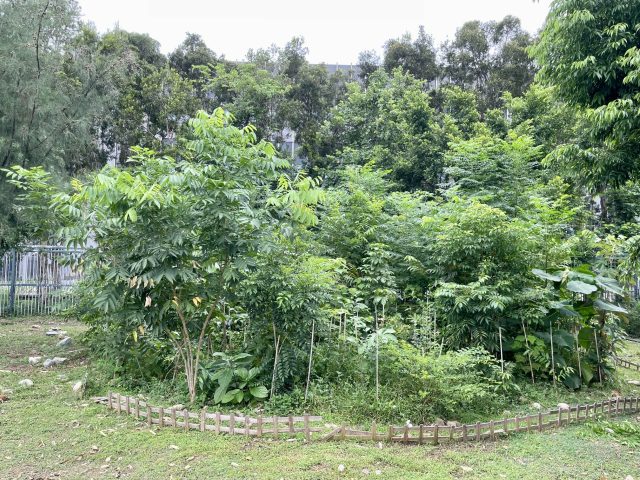
Miyawaki forest circle. Source: Camilla Zanzanaini
CWR: Can you share a success story of one of your forest sites? What kinds of environmental, social, or economic benefits has it brought to the property?
CZ: We planted a forest at WEEE Park last year and I’m happy to say the tallest trees are already 5m tall – that’s only within 15 months. A few trees fell during Typhoon Ragasa, but they were propped back up and are all retaking.
At the one-year mark, we assessed the biodiversity of the grassy area near the forest and within the forest and found a 400% difference in insect and soil microorganism life!
My biggest measure of success is the mindset shift away from pesticides & pulling out weeds
To be honest, my biggest measure of success is not the soil or nature, but the mindset shift of the people who are managing it. WEEE Park has done an amazing job, but the first few months were tough because they had a third-party contractor that is trained to manage gardens and landscapes in a completely different way. They’re used to using pesticides, pulling out weeds – including native plants! So that’s a really big knowledge curve.
In terms of benefits, the outdoor education component is a big attraction for schools. Students get involved with planting and maintenance, so they learn firsthand about nature and get close to it. We also do workshops with identification and uses, giving kids a chance to learn more about Hong Kong’s biodiversity.
As we get bigger, we are getting more commercial interest for CSR, mental health and wellbeing. The forests can be set up with a cleared space that could be rented out for things like wellbeing workshops.
If you’re managing a space for 2+ years…
…a Miyawaki forest will save you maintenance money
I don’t know if a Miyawaki forest will make you money directly, but it will save you money because after the first couple of years, you basically have no more maintenance. There’s an upfront cost to setting it up that will most likely be more than if you were just to plant some generic plants, but if you’re managing a space for 2 or more years, then it will save you money in the long run because you’ll no longer have to take care of it basically.
Some people have asked me about carbon offsets, but at this stage, the forests are not of the size or scale yet to make it worth that pathway. We’ll probably have to revisit that a bit later.
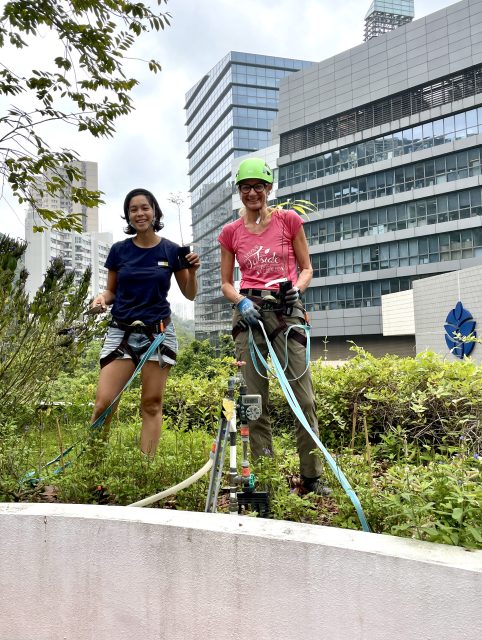
Safety planting at ISF Academy. Source: Camilla Zanzanaini
CWR: Your forests also serve as educational sites for nature-based learning. What are some biodiversity facts you wish more people would know?
CZ: That not all green is the same. Unfortunately, a lot of the landscaping in Hong Kong doesn’t provide any value for biodiversity and provides much less value for humans than it could.
An HK native forest provides physical benefits that a Disney exotic forest cannot
The colour green itself does create a soothing aspect and there are studies saying that spending 20 minutes in nature reduces stress. But that doesn’t apply to just any kind of nature. If you went to a Disney version of an exotic forest that has no life in it – no birds, no insects, no microorganisms in the soil – the physical benefit would be different than if you went into a Hong Kong native forest. This is because it’s alive in a completely different way. In an ecosystem that provides food, habitat, good oxygen and healthy soil, it’s the organic compounds released that helps reduce stress levels.
My other wish with Hong Kong is insect appreciation. So often the first question I get from people is, do you get mosquitoes? Well, yes – you’ll get mosquitoes whether there’s a tree or not because mosquitoes come with stagnant water. When you have a green space with good absorbent soil, you will get less stagnant water. And if you have a functioning ecosystem, you will have natural predators like frogs and dragonflies which will eat mosquitoes.
They will never completely disappear because they’re an important part of the food chain. You also cannot handpick which insects you want. If you want bees and butterflies, you’re going to have to tolerate some mosquitoes as well. Health wise, an organic space with some mosquitoes is also a much safer option than spraying pesticides in the areas that we sit, play or eat.
CWR: Can Miyawaki forests help Hong Kong build resilience to climate impacts, such as more frequent typhoons, heavy rains, and hotter temperatures?
CZ: Our first forest was planted in a primary school in Tai Po in an area of the school that used to be flood-prone. They also had problems with mosquitoes breeding and had to get someone in to drain it every year, which was a big headache. Now the forest is 4 years old, and the part that used to flood has become the most luscious part of the forest!
Typhoon Ragasa took down 2 neighbouring trees but left the 4 y/o forest intact
Typhoon Saola hit a few years ago when the forest was a bit younger and a couple of trees fell, but the school managed to prop them up. They’ve survived and are still doing well. This September during Typhoon Ragasa, the forest had no damage at all, even though they lost two other big neighbouring trees on campus.
That forest is now self-sufficient, and the school no longer needs to maintain it. It actually towers above so it feels like an actual forest that envelopes you when you step inside. The highest temperature difference we’ve recorded in the summer when comparing the forest to the concrete area nearby, was 15°C.
But a Miyawaki forest cannot replace the functions of old large-scale forests…
My only caveat is that while a Miyawaki forest can help, it cannot replace the functions of old large-scale forests. A 200-year-old tree has way more value than a new tree. As fast as a Miyawaki forest can grow and create space for diversity, possibly on par with what a 100-year-old space can do, we have to be careful that Miyawaki forests are not used as an excuse to cut down existing forests or to not conserve other natural spaces which also provide very important biodiversity and resilience to climate impacts.
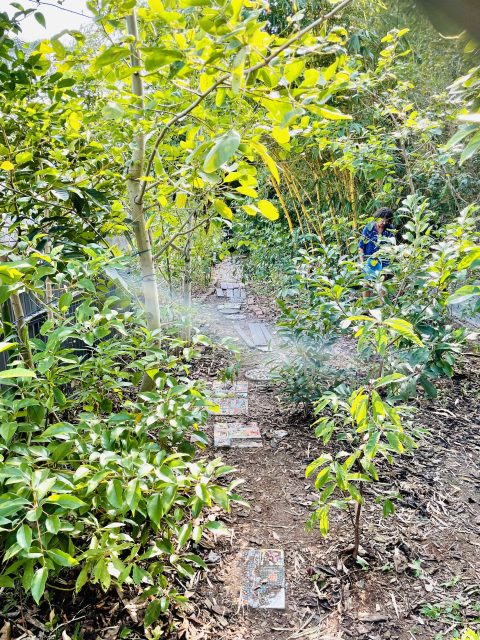
ICHK forest at 2 years old. Source: Camilla Zanzanaini
CWR: Lastly, in your wildest dreams where do you wish to take Nature Makers Lab? What would you need to get there?
CZ: What Nature Makers Lab is doing now is creating little hotspots of biodiversity, but I would love to see that extended into biological corridors from ridge to reef, mountain to sea, so that there’d be a seamless connection between all the natural areas of Hong Kong.
Biological corridors would let biodiversity travel across HK seamlessly
In the same way we commute as much as we want on the MTR, biological corridors would let a bird, boar, porcupine or a bee move across pockets of forests throughout the city. What’s great now is that Hong Kong has conserved beautiful country parks, but they’re all in the hills. How can we bridge all these lovely nature hotspots so that biodiversity can travel between them? At the end of the day, protecting biodiversity is about reducing habitat fragmentation.
How do we get there? On the practical side, we need a much greater supply of native plants. There are very few sources of local native species – they’re hardly any at the flower market and Kadoorie Farm is a key source but they don’t have enough to supply all of Hong Kong. Also, they mostly focus on trees, whereas we’re looking to expand to other plants as well because not everybody can plant a tree, but most people can plant flowers or shrubs.
Currently, we’re working on a small native seed nursery to help increase supply. And as we plant more Miyawaki forests, I see them becoming living nurseries that can help replenish themselves and spread more seeds around the city. If we can get as many people as possible interested in native plant nurseries, that would be a huge win to getting there.
Further readings
- A Conversation with Jenny Quinton: Eco-education, Biophobia & Nature Healing – Nestled in the forests of Lantau Island, Ark Eden is a “green paradise” for HKers to escape stress & reconnect with nature. We chat to its founder Quinton to find out how eco-education can help heal the planet & our relationships
- A Conversation with Dr. Kongjian Yu on Restoring Our “Sponge Planet” – Concrete cities are ill-equipped for extreme rainfall & flash floods. But can we fix that by blending old tech & philosophies with modern ones? We chat to the “Father of Sponge Cities,” Dr. Yu, to find out more
- Dreaming Of A Regenerative Economy? – Co-founder Dr. Schillebeeckx explains how Handprint helps restore ecosystems with every purchase
More on Latest
- AfterNature’s Dr. Chi Chiu Lo on Coastal Adaptation with Living Shorelines – It’s not just people – coastal ecologies must also adapt to a future world. Dr. Lo shares how ecological engineering can defend shorelines while enriching life above & below water
- Can Arctic Sea Ice Impact Hong Kong’s Weather? Dr. Cen Wang Explains – From polar vortex surges to sea level rise, atmospheric scientist Dr. Wang’s research explores the deep connections between the Arctic & Asia’s coastal cities
- Hong Kong’s Small But Seismic Innovations For the Future – Innovation isn’t just about applying AI to everything, says CWR’s Chan, but solutions that expand new ways of thinking about complex climate & resource challenges
