
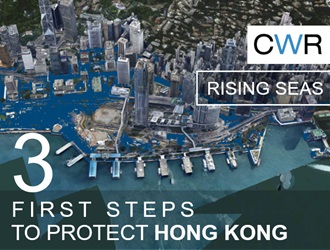
3 First Steps To Protect HK From Rising Seas
By Debra Tan, Chien Tat Low, Ronald Leung 24 September, 2021
The IPCC AR6 warnings on rising seas bring bad tidings for HK. See 3D maps of areas submerged and get on top of what you need to do to survive, adapt & thrive
CWR will be running some Re-IMAGINE HK labs to brainstorm climate adaptation outcomes. Email us if you would like to participate.
The IPCC AR6 Code Red warnings bring bad tidings for Hong Kong. There will be many challenges ahead as Hong Kong is already tracking the worst-case scenario for some impacts but if there is one that will blindside us, it’s rising seas. Here are 3 must-do’s to prepare for rising seas.
1. Get real! If you are 20 and younger, Hong Kong could become the new Atlantis in your lifetime
Climate science is fast-evolving and you may not have caught up with the latest – it’s time to get real. Many of us feel that sea level rise (SLR) is not something that we need to worry about right now as we believe it will only happen in a hundred or few hundred years’ time. And we were not wrong to have thought this under the past projection models. But that was then…
If your age ≤20, HK could become the new Atlantis in your lifetime
Now, multi-meter SLR cannot be ruled out before the end of the century, the IPCC AR6 has warned. In short, if you are 20 and younger, Hong Kong could become the new Atlantis in your lifetime, unless we take action now.
Scientists worry over an abrupt jump in SLR ~2060 if we are to continue on a 3°C path
The latest observations of climate impacts have led scientists to worry over an abrupt jump in SLR around about 2060 if we are to continue on a 3°C path. This means that if you are in your 20s or 30s today, you will see this “abrupt jump” in rising seas in your 50s or 60s.
Also, by then, you will likely face a T10 typhoon like Mangkhut every year. Imagine what that would be like … 5m storm tides on top of multi-meter sea level rise. It’s dire. This is our current policies path. By the way abrupt jumps in SLR are not uncommon … we saw this between 1990-2020 in Hong Kong – more here.
By the time the 20 year olds are in their 80’s, Queen’s Road Central will be Hong Kong Island’s new coastline. Since this is hard to imagine, we’ve created some 3D maps to show the impact from rising seas – this is what Hong Kong will look like by 2100 …
If you are young, this could be HK in your lifetime … permanently underwater unless we take action now! 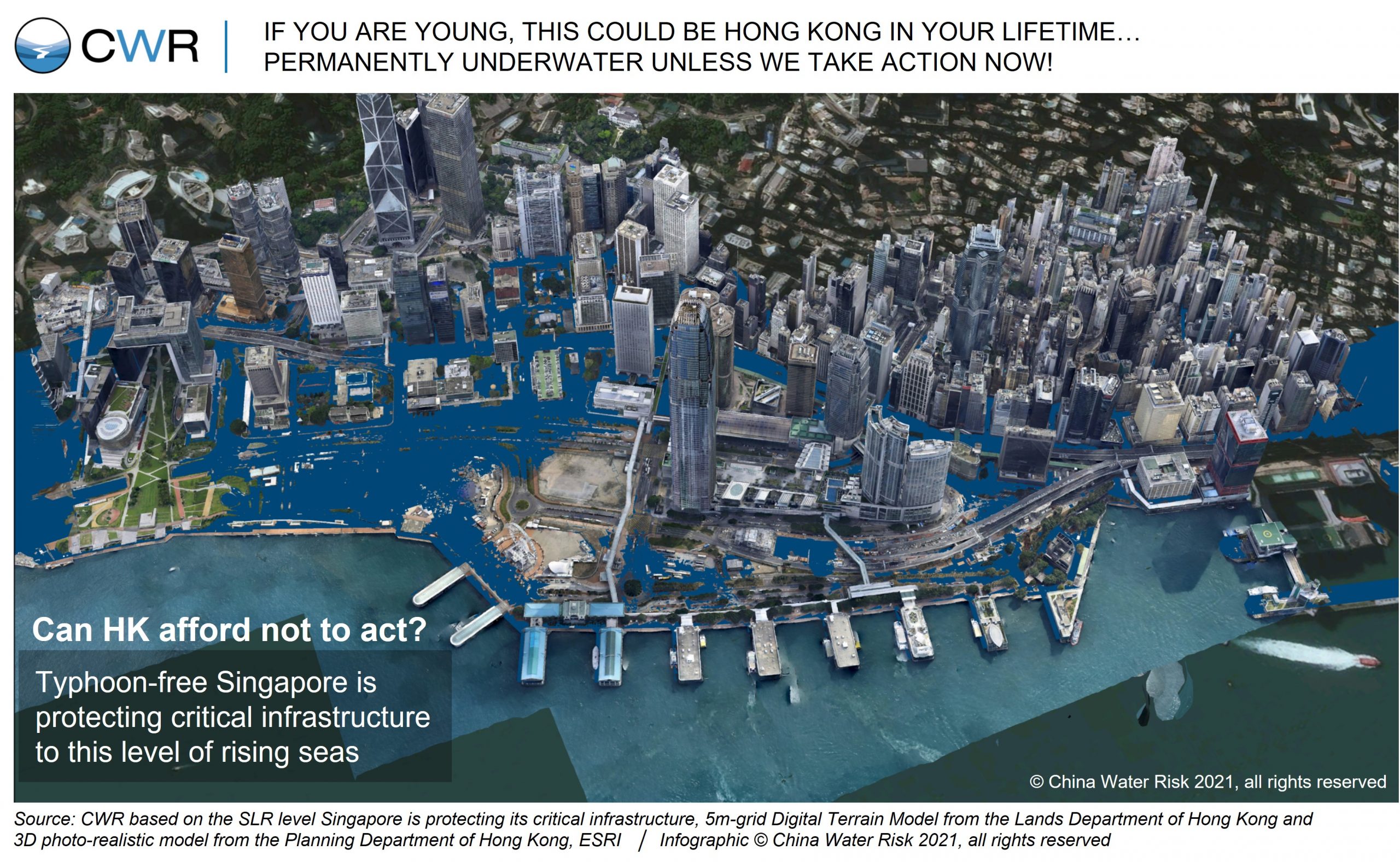
Pay attention! You could lose your home by investing in the wrong place & your savings
So, get it in your head now – rising seas is NOT something happening some generations in the future, HK youths will likely see multi-meter SLR in their lifetime (see HK’s SLR projection chart here). As for the 40+ with kids, your children will definitely bear the brunt of this.
Pay attention! You could lose your home by investing in the wrong place and your savings as billions of dollars will be at risk unless we recognise these risks now and take action. Read on …
2. Fast track carbon neutrality! The only thing that can stop this is rapid decarbonisation by 2030
What we will face in the future depends on what we do today. The only way we can stave off rapid multi-meter SLR is rapid decarbonisation by 2030 to the tune of a 45% reduction from 2010 levels. FYI, COVID only provided a 6.4% reduction in carbon emissions.
We are careening down the 3°C path as all of the G20 countries are not meeting the Paris Agreement’s 1.5°C goal
So, can we steer our current policy path of 3°C to 1.5-2°C? To do so, efforts need to be made before 2030. Sadly, according to Climate Action Tracker we are careening down the 3°C path as all of the G20 countries are not meeting the Paris Agreement’s 1.5°C goal.
“The momentum on updating 2030 targets for climate action has stalled since May, with no major emitters putting forward stronger climate targets” said the tracker. As of today, it classifies the targets set by the higher income countries such as the US, EU, Germany and Japan as “insufficient”.
Worse still are targets set by Australia, New Zealand, Canada and South Korea – they are deemed “highly insufficient” alongside the targets set by lower income countries of Argentina, Brazil, China, India, Indonesia and Mexico. As for Russia and Saudi Arabia, they are far behind with “critically insufficient” targets according to the tracker.
The G20 can throw a Hail Mary with bold & serious steps – tgt they produce 90% coal, 63% oil & 63% gas
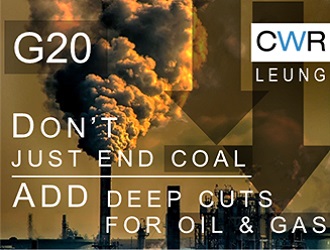
This is hardly encouraging news but this doesn’t mean that the G20 cannot throw a Hail Mary. The G20 Accounts for 85% of global carbon emissions and could take bold and serious steps to stave the climate crisis. Plus there is no reason why they cannot deliver because the G20 produces 94% of global coal, 63% of oil and 63% of gas.
Surely the amount Australia will spend on AUKUS is better spent on helping vulnerable Pacific nations adapt to rising seas?
Putting aside political bickering is the adult thing to do but striking an AUKUS deal (Australia, UK & US) ahead of COP26 does not exactly send collaborative signals across other APAC countries. If the goal is to build regional security, surely in this ninth hour, the amount Australia will spend on nuclear submarines could be better spent on helping Pacific nations adapt to rising seas.
Indeed, 48 most vulnerable economies led by the Vulnerable 20 (V20) are demanding a “2020-2024 delivery plan” for the missing $100 billion annual Paris Agreement climate assistance promised.
HK should fast track carbon neutrality to 2030-40 by upping green energy from the GBA
But the G20 countries are not the only ones that are lagging, Hong Kong is too. We’ve said we’ll strive to achieve carbon neutrality before 2050 last year but we’ve yet to set out a roadmap of how to get there. Hong Kong should fast track this to 2030-2040 by increasing the supply of green energy (nuclear & renewables) from the Greater Bay Area (GBA); upping it from the current 27%.
At the same time, we should invest in promising but immature technologies such as carbon capture and hydrogen so that we can evolve toward a diversified energy spread in the second half of the century. This is a no brainer due to our coastal exposure which brings us to point #3…
3. Be prepared – embrace the threats! IPCC AR6’s warnings mean HK must adapt, adapt, adapt …
Our analyses using IPCC’s latest SLR warnings show that by 2050, a Mangkhut like T10 typhoon could hit Hong Kong every year, affecting up to 10% of Hong Kong’s land and 1.62 million residents. Kowloon and Hong Kong Island would be the most affected districts in terms of the share of residents impacted. By 2150, using IPCC’s latest SLR warnings, 15% of land and 43% of the population or over 3 million residents could lose their homes to rising seas.
Download Hong Kong’s coastal threat impacts snapshot by 2100 and 2150 below:
Re-IMAGINE HK 2100 Coastal Threat Snapshot 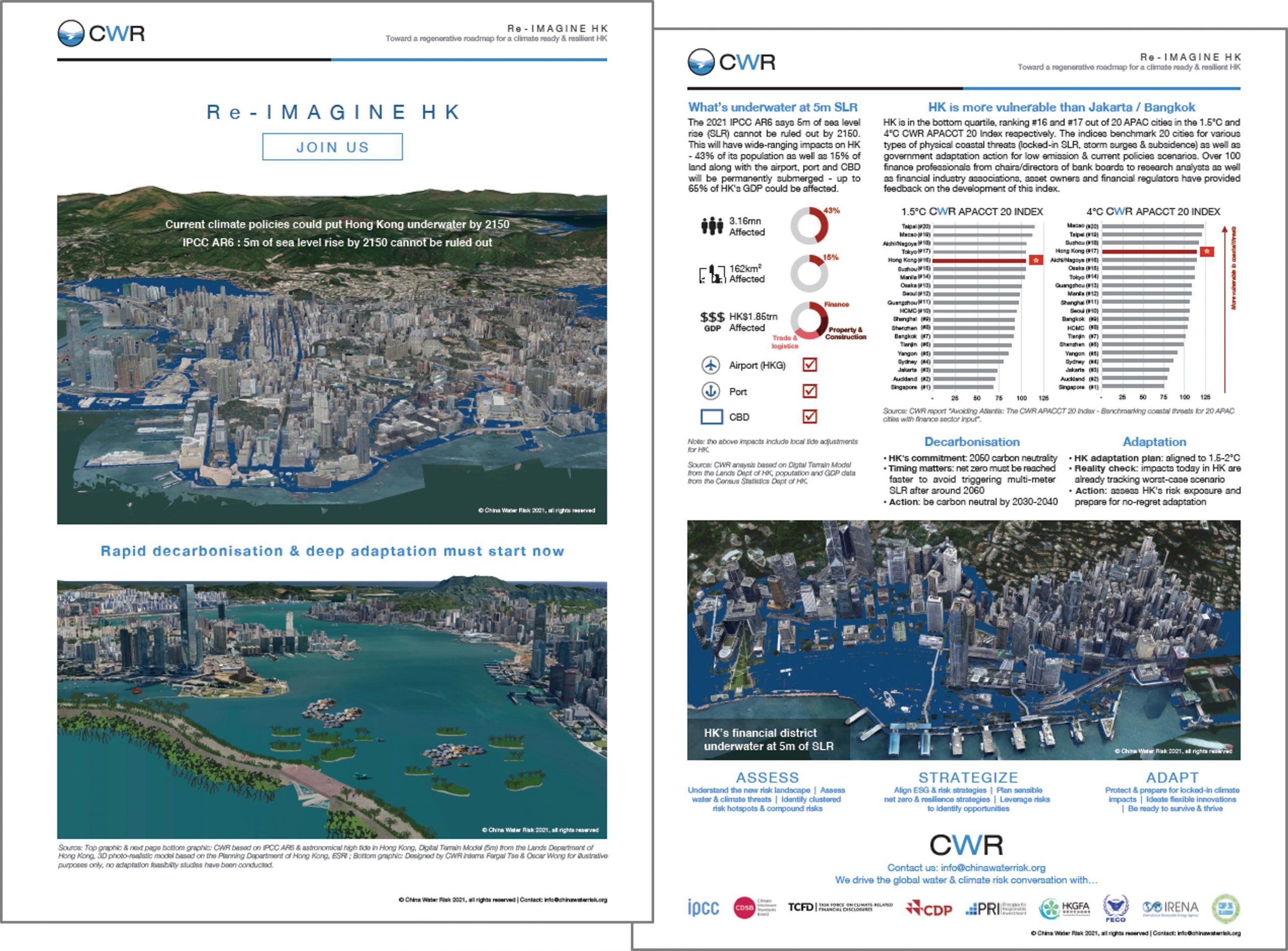 |
Re-IMAGINE HK 2150 Coastal Threat Snapshot 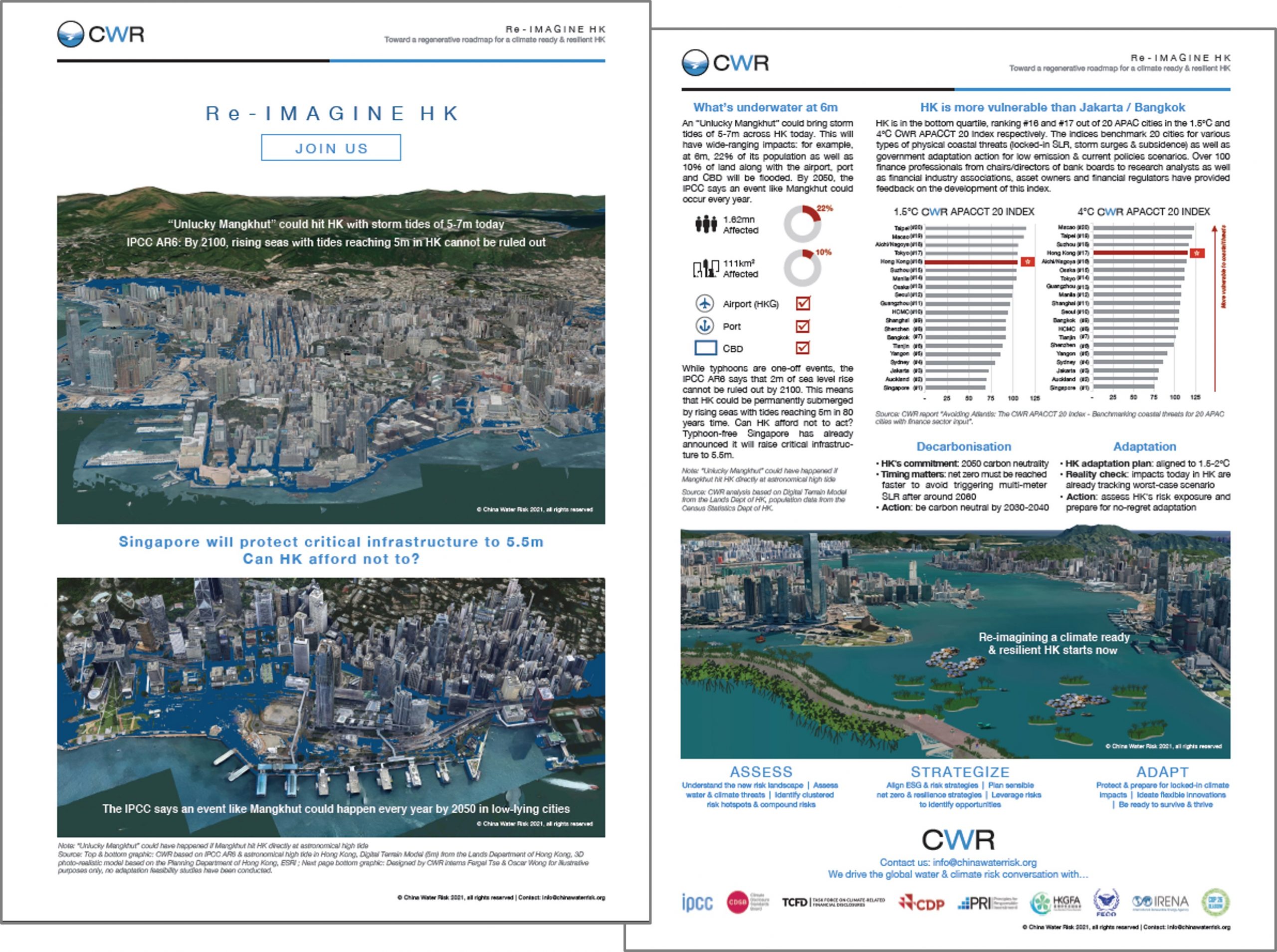 |
Up to 65% of HK’s GDP could be affected by rising seas – finance, property & construction + trade & logistics hit
Up to 65% of our GDP could be affected by rising seas as Hong Kong’s key sectors of finance, property & construction and trade & logistics will be hit when prime real estate, the airport and ports become permanently submerged.
Yet unlike Singapore, which has already acknowledged its vulnerability and is moving to protect the city and residents, HK has yet to make any public announcement on deep adaptation to coastal threats. Indeed, HK ranks in the bottom quartile in our indices which benchmark coastal threats exposure of 20 APAC cities.
We are in denial…70% of HK’s economic activities & ~27% of population are on reclaimed land
We are in denial. Why else would Hong Kong still be going about coastal construction projects as if seas are not rising at all? Kowloon West, Kowloon East and Lantau Tomorrow Vision (LTV) to name a few. Is it because we didn’t know we are vulnerable?
But we should as HK’s Chief Secretary for Administration said “as at 2016, there are about 7 000 hectares of reclaimed land, accounting for 25% of our built-up area and accommodating around 70% of our economic activities and nearly 27% of our population” (ironically in an impassioned plea as a case for LTV).
Hmmm… given that reclaimed land is both low-lying and coastal, the amount of assets clustered in them makes Hong Kong just as vulnerable to rising seas as Fiji and the Maldives.
Interestingly, both Hong Kong and Singapore are spending around a fifth of their respective GDPs on large infrastructure projects – Hong Kong on LTV and Singapore on coastal protection. Don’t get us wrong, we are not saying that we don’t need public housing, we do … but we must build public housing that will survive the new climate threats ahead.
We must take rising seas as seriously as Singapore
There’s no doubt rising seas will threaten Hong Kong’s very existence and we must take rising seas as seriously as Singapore, which has announced that it will raise its critical infrastructure to 5.5m above current sea levels.
At these levels, West Kowloon is lost as is East Kowloon – see maps below (click on them to enlarge). The question here for Hong Kong to ask is not “if these SLR levels will occur” but “can Hong Kong afford not to act?”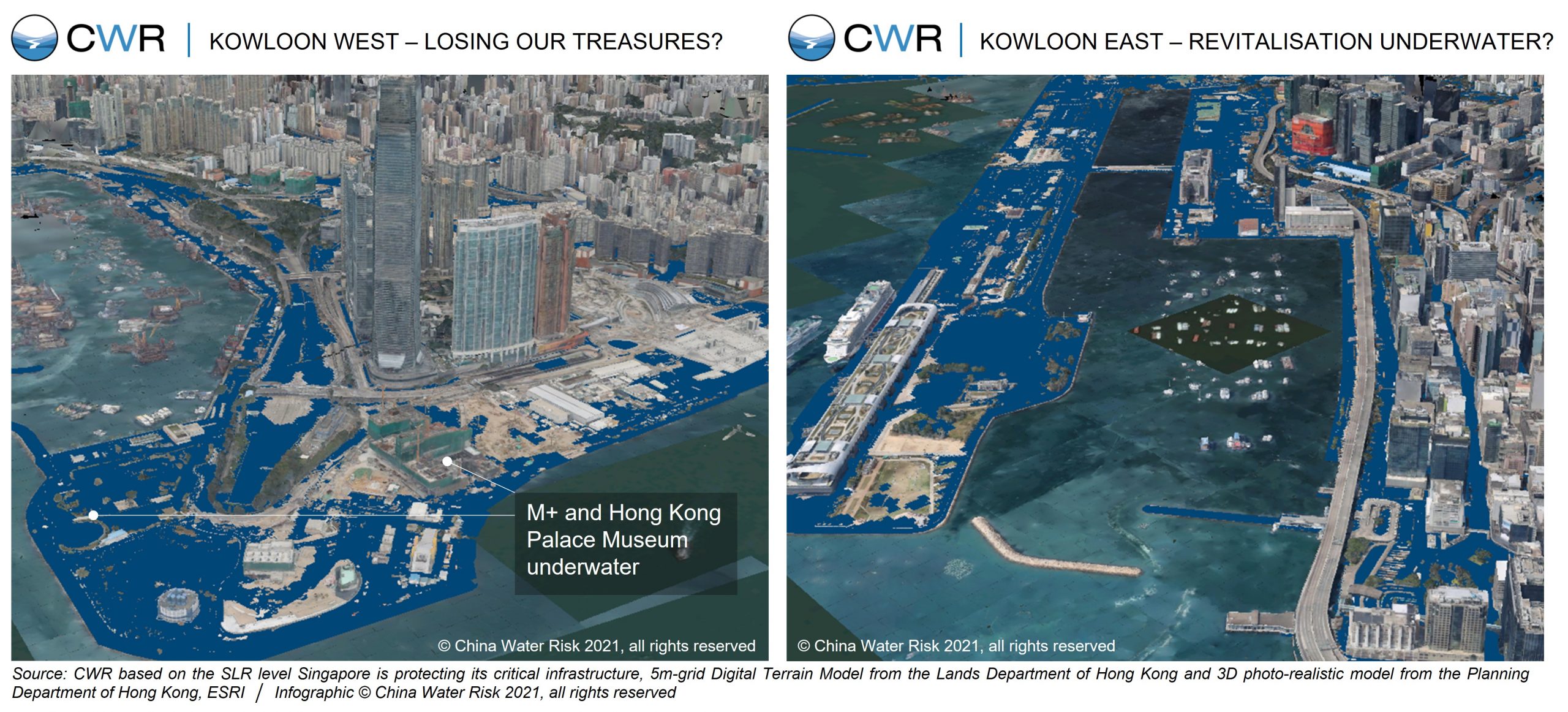
Time to Re-IMAGINE HK and build a carbon positive, climate ready & resilient city
Not taking action is borderline reckless.
Do not deny the existential threats ahead, embrace them …
We must adapt to thrive
We get it, you didn’t know it’ll be this bad, this fast. SLR impacts are not obvious like flash floods or storm tides from a typhoon. But now that you know, do not deny the existential threats ahead, embrace them. We must get on top of “what will kill us” and “what will keep us alive” and since climate science is fast-evolving with threats advancing, we must adapt to thrive – it’s time to Re-IMAGINE HK.
Clearly, not taking action is borderline reckless. And so we expect to see rapid decarbonisation plans in the upcoming policy address in October plus we are feeling optimistic that the need to protect Hong Kong from rising seas will also be mentioned.
We must all chart a regenerative roadmap
Since it’s clear we will ALL be affected, we must all roll up our sleeves to chart a regenerative roadmap for a climate ready & resilient Hong Kong.
There’s no reason why we can’t do this…
…HK has had multiple firsts in coastal engineering
Yes, it will be scary and there will be many firsts but there’s no reason why we can’t do this as we have done it before. Hong Kong has had multiple firsts in coastal engineering … the world’s first freshwater coastal lake from an arm of the ocean with the Plover Cove Reservoir; followed by another with High Island Reservoir plus we also constructed the longest bridge-cum-tunnel sea crossing in the world.
And let’s not forget we have three cross harbour tunnels.
Hong Kong has 1,180km of shorelines & it costs $7,000 to protect 1m… Kerching!
The Prime Minister of Maldives estimates that it costs $7,000 to protect one meter of shoreline in the Maldives. Hong Kong has 1,180km of shorelines so go figure … kerching! Yes, we must remember that threats also represent opportunities.
Can our buildings withstand rising wind speeds from typhoons? A grand redesign of HK is on the cards …
And it’s not just rapid SLR we will have to contend with. As HK is tracking worst-case scenario projections, we will also need to prepare for hotter days and flash floods from more extreme rains, plus there may come a day when our skyscrapers may no longer withstand rising typhoon wind speeds. A grand redesign of all Hong Kong buildings, transport and essentials is on the cards.
Re-IMAGINE a HK that still thrives in a vibrant GBA even when our 20 year olds are in their 80’s
Faced with this once-in-a-lifetime opportunity to Re-IMAGINE HK, we must grab it to build a city that is carbon positive, climate ready and resilient. But we must be mindful not to “Build Back Better”, but to “Build Forward Better” to cater for the deep uncertainties ahead from climate risks.
We must innovate and reach for the sky to Re-IMAGINE a Hong Kong that still thrives in a vibrant GBA even when our 20 year olds are in their 80’s.
Hong Kong’s youth can lead the way on deep adaptation
It’s their future! The youth must be involved
And since it is the youth that will see these impacts, surely they must be involved in designing their future? On this note, we leave you with something our 20 year old interns, Fergal & Oscar imagined below – and no they are not studying climate change, they are studying design & architecture – but even they have figured out that they need to break out of their silo to do something to save Hong Kong from going underwater.
The IPCC AR6 says it is virtually certain that seas will continue to rise even if we are net zero today. There’s no running away from this so join us to Re-IMAGINE HK now!
Don’t run away, join us to Re-IMAGINE HK
We will also be running a series of Re-IMAGINE HK labs to brainstorm how to safeguard Hong Kong.
Email us if you would like to participate!
Further Reading
- Code Red: 8 things you need to know about water in IPCC AR6 IPCC AR6 is a code red for water too! CWR’s Debra Tan shares 8 things you may have missed on water and urges to delay no more
- Existential Coastal Threats: 8 Things You Must Know – Rapid SLR will happen sooner than we think, yet we are still driving investments to vulnerable locations. CWR’s Debra Tan shares 8 things you need to know about the existential threat from SLR – from glaciers in the mountains to ice sheets in our poles, permafrost + more
- 3 Ways To Deal With The Deep Uncertainty Of Sea Level Rise – SLR uncertainty is here to stay but it can be minimised as discussed at SIWW 2021. CWR’s Ronald Leung & Dawn McGregor share what the climate & planning experts advised
- Sea Level Rise – What The Science Tells Us – What’s the latest on sea level rise projections? HKU’s Dr. Nicole Khan shares key findings from her survey of 100+ sea level experts, as well as talks risks to Hong Kong and what we should take away from COVID-19
- Future SLR Projections & Biggest Worries – In this follow up interview, HKU’s Dr. Nicole Khan shares her biggest concerns on how future SLR projections are rising higher & faster than thought & shares the best approach for building realistic scenarios
- 2021 World Water Week: 3 Key Action Takeaways to Build Resilience Faster – 2021 World Water Week gives 3 important action takeaways for us to charge forward & build resilience faster – CWR’s Soomin Park breaks them down
- Sponge City Is Transforming Urban Flood Management – Sponge city was launched to combat urban flood risks yet public has doubts over its effectiveness. What does the Chinese govt do to promote the policy? What role does social media play? Dr. Faith Chan, Dr. Dimple Thadani & Lei Li break it down
- Not Just a Drop in the Ocean – Global water guru Professor Asit Biswas & Singapore PUB’s CEO Peter Joohee Ng share how the country is setting the example on climate change & water mgmt by formulating long-term plans despite only accounting for 0.1% of global GHG emissions
- Hong Kong Is Tracking Worst-Case Scenario Impacts – 8 Reasons To Act Now – With this summer of rising climate risks, don’t get caught out. CWR’s Chien Tat Low & Debra Tan run through 8 reasons why Hong Kong must act now to get on top of advancing climate threats – from hot weather, strong winds to flash floods – be prepared!
- Designing Resilience – 2 Architectural Students’ Take on Coastal Threats – Shocked by HK’s coastal threat, HKU’s Fergal Tse & Oscar Wong became CWR’s interns to re-design Victoria Harbour. We sit down with them to understand what local youths think about climate change and & their projects with CWR changed their perspective

Read more from Debra Tan →

Read more from Chien Tat Low →

Read more from Ronald Leung →
